Monday, December 5, 2011

Of the mature rivalry between PAP and WP

Perhaps things are beginning to look up for the local political scene now that PM Lee has acknowledged that there are no longer any "sure-win constituencies". WP's Chen Show Mao has succinctly spelt out what it means for Singaporeans to have a voice for the good of the nation. We live in interesting times.

A mature rivalry between PAP and WP?

Singapore's ruling party for 46 years has sounded a warning to its followers that its era of easy election victories is over.

Future contests would be tougher, said Prime Minister Lee Hsien Loong, who added that he no longer expected "clean sweeps" or "safe wards anywhere".

Lee appealed to 1,500 party activists to help him build a new People's Action Party (PAP) for a new phase.

This was its first convention since the poor election showing six months ago.

Last week, as PAP prepared for its crucial meeting, rival Workers' Party (WP) launched the biggest offensive in the East Coast constituency since May.

It lost narrowly to the government (45-55 per cent) and appears determined to win it in 2016.

While Lee was exhorting his party to work hard to regain lost ground, WP members — wearing blue — were out in force at hawker centres and markets to sell the party organ The Hammer to families.

The two events show the extent of Singapore's political intensity although the next election is still five years away.

Both sides have appealed to Singaporeans not to let the political divide create rifts in society.

After years of acquiescence to former prime minister Lee Kuan Yew, who governed Singapore with an iron hand, a new generation of Singaporeans is beginning to assert itself.

As a result, politics is steadily becoming a passionate subject and quite unpredictable, with more people who stayed away before taking sides now.

Friendly match

Several opposition parties are emerging as challengers, but as of now only PAP and WP, the two oldest parties here, figure strongly in the contest.

Both are committed to pursue their politics with a sense of maturity and responsibility so far.

Lee had earlier surprised Singaporeans when he invited six Workers Party MPs to join parliamentary committees to play a recommendation role in policy- making.

With Kuan Yew no longer in the Cabinet, although still an MP, the younger set of MPs from both sides is trying to find a practical way to work together.

The political landscape is changing, but what the present House will do will leave its mark — good or bad - in history.

There has been video coverage of opposing MPs organising joint community functions for residents, their differences temporarily laid aside.

Last month, the MPs formed a football team, complete with red jerseys, to play a friendly match against a team made up of media representatives.

The politicians, among them two opposition MPs, lost the match 2-1.

The general reaction, especially among younger Singaporeans, was one of excitement and people want to see more of such matches.

"It was good to see them put aside their political differences and fight a common battle on the same side," said a Malaysia Cup fan.

He suggested the Singapore MPs team take on Malaysian politicians in a similar match as a prelude to the Malaysia Cup kick-off.

The younger generation is watching with interest to see how the two parties treat each other.

'Not the enemy of the government'

Unlike other Asian countries, Singapore has rarely had any real experience of intense Parliament debate since the left-wing Socialist Front quit Parliament and took to the streets.

A few sharp exchanges had taken place between Lee Senior and the late J.B. Jeyaretnam, but that was prior to the emergence of the Internet and mainstream coverage was minimal.

The newly-appointed Speaker Michael Palmer has urged MPs not to get lost in "the quagmire of party politics".

Writing in an editorial for PAP magazine The Petir, Palmer said worthwhile suggestions should not be attacked just because they were made by the opposition.

From the other side came utterances like the following from Workers' Party MP Chen Show Mao:

"Let me state quite clearly how I see myself as an opposition member of this parliament. I may challenge government policy in Parliament, but I do not by definition oppose government policy.

"It does not mean that I do not support the government in its work. I am an opposition MP and will perform my role to voice alternative and opposing views in the law- making process.

"As an opposition MP, I am not the enemy of the government; I am a Singaporean and a patriot."

PAP's behaviour towards its rivals has taken a sharp turn for the better.

Possible motive

Some observers see a possible long-term motive in why the two parties — whose ideological differences are not very wide apart — wish to compete without personal attacks or animosity.

Firstly, Singaporeans are by and large moderately inclined and dislike to see politicians at each other's throats.

The second reason is that both parties are pragmatic enough to realise that politics is entering an unpredictable phase.

Few can be sure whether one day one may need the other in a realignment of interests.

The ruling PAP is facing an uphill task trying to attract quality candidates from the private sector to stand in elections.

According to WikiLeaks, the leaked US diplomatic cables, PAP MP Charles Chong admitted that the party had to field "second and third-tier candidates" since the 2006 election.

Unless PM Lee succeeds in rever­sing his recruitment fortune, the next election could spell greater trouble.

No one really believes PAP will be overthrown but if it fares badly, having a workable relationship with the rival will be a very useful thing.


Monday, November 21, 2011

Of freedom of speech & freedom to post

In a span of 5 days, the police have been called to investigate 3 cases of racist posts in a public domain. It first started with Jason Neo, a then YPAP member and Christian Eliab Ratnam, a NSF. In an earlier Facebook posting, Christian was reported to have agreed with a statement attributed to LKY. The most recent person to be investigated is Donaldson Tan, former member of The Online Citizen, founder of New Asia Republic.

Given that Singaporeans spend the most time on Facebook at an international level, it probably comes as no surprise that all three postings took place over Facebook. While the internet has been widely attributed as a tool to empower freedom of speech, people or in this case, Singaporeans need to know that they cannot simply tap on the phone or click on a computer to post something sensitive without repercussions. Yes, the internet empowers. It is also a public domain. Even without policing, what is sent out easily goes viral and you, yes you become a victim of your own posting.

I sincerely believe that Singaporeans are not racist by nature. Yet despite the government's attempt at schooling racial harmony, Singaporeans incline toward racial nonchalance. We are not tolerant but largely indifferent to the requirements of other races and religions. It is due to this lack of awareness that people fall prey to their own fastest fingers. All the same, regardless of my theories, I do not condone any such act.

Freedom of speech does not equate freedom to post. People have rights to freedom of speech and rights to live free from racial vilification.

Wednesday, November 16, 2011

Of risque ads

Hi Singapore, if you think the Abercrombie ad was bad, look at this...

Sure pales in comparison doesn't it?

risque ad

Sunday, September 18, 2011

Of the ISA. True abolishment or a facade of skull-duggery?

This post is a response to a very lengthy article posted on Channel News Asia here.

Since Malaysia's Prime Minister Najib Razak declared that they (Malaysia) will abolish the ISA, local NGOs and political figures have also begin to adovcate / renew these calls.

It is unlikely that Malaysia will abolish the ISA. More likely, PM Najib is "doing the groundwork" before the 13th Malaysia general elections. Look at the recent Bersih protest in July this year. After talks with the King, the organisers of the rally agreed to change the street protest to the Merdeka Stadium, an indoor venue. Subsequently, the organisers were refused usage of the stadium and a permit to conduct the protest. On the evening of the protest on 9 July 2011, the police had confirmed 1,667 arrests, including 167 females and minors. Most of the arrested protesters were freed by the end of the day.

Of course the above factual information has little to do with Singapore. Yet it is precisely because of PM Najib's claim that has set off a chain reaction in Singapore. All calls to abolish the ISA from local NGOs and political figures have cited examples from the 1950s-1970s. Then, the ISA was used to detain persons suspected of agitating racial and religious discord, and persons engaged in espionage. The ISA was also controversially used in 1987 against alleged Marxist anti-state conspirators involved in several Catholic church and civil society organisations.

In recent times, the ISA has been used primarily to deter terrorism. This is where Mas Selamat and the suspected Jemaah Islamiyah (JI) terrorists come in. Here, it is unfortunately hard to disagree with pre-president Tony Tan when he said that the "ISA is a blunt instrument". If there were no ISA, do the authorities only arrest the terrorists after Yishun MRT station had been bombed? After all, a terrorist is only a terrorist when an act of terror has been committed no? Like a suicide bomber can only be labelled as such after a successful act of self-immolation. I take it that the officers at the Home Affairs and Internal Security Department have done all the necessary security checks in confirming the terrorist links before detaining those suspects.

More importantly, could 911 have been averted if the Americans had the ISA?

Singapore has come a long way since the 1950s threats of communism. In present times, the authorities cannot simply arrest anyone under the ISA for "agitating racial and religious discord, and persons engaged in espionage". While Singapore doesn't score much on human rights, it is unlikely that they will do an "Aung San Suu Kyi". Even the outspoken Dr Chee Soon Juan has never been convicted under the ISA.

So what other laws can Singapore apply to deter terrorism? I suggest that the ISA be refined instead of totally abolished. Refined so that it cannot be used to benefit one political party and for all other petty reasons. After all, I would rather the authorities come clean and say "We are keeping the ISA" instead of saying that they will abolish it (and rebrand it as another law) for the sake of gaining populist points.

As for Malaysia, let's see how much more PM Najib has to offer. Elections in Malaysia are not due till 2013. Would the ISA be repackaged as XXX version 2.0? Only time will tell.

Wednesday, August 3, 2011

Of August, and the road to a new president.

Would there be drama on 17 August, Nomination Day? Would one of the Tans enter the nomination center and be the elected president just like how an unknown became an MP in 24 hours only 4 months ago? Andrew Kuan has until 1pm this Saturday to submit his application for a Certificate of Eligibility.


If you haven't been in touch with the happenings of the presidential elections, the Tans i.e. Tony Tan, Tan Kin Lian, Tan Cheng Bock and Tan Jee Say have submitted their eligibility application forms. With the outcome of the recent general elections fresh in the candidates' minds, it seems that the way to popularity is to appear populist by claiming their independence from the government. To prevent the further eroding of the moral authority i.e. 4 million annual salary ceremonial figure, may the best Tan who has claimed to do what he would, win.


Today Online:Presidential Election on Aug 27

Writ of Elections issued yesterday; Nomination Day is Aug 17

SINGAPORE - In 13 days, Singapore will know if there will be a contest for the job of President of Singapore.

Prime Minister Lee Hsien Loong issued the Writ of Election yesterday announcing Aug 17 as Nomination Day.

If more than one candidate qualifies to run, Singaporeans will go to the polls 10 days later, on Aug 27, to pick the Republic's third Elected President in what will be only the second contested election since 1993.

Candidates have until 1pm this Saturday to submit their applications for a Certificate of Eligibility.

Five people have declared their intention to contest in the Presidential Election. Their candidacies are subject to the approval from the Presidential Elections Committee, which will issue the certificate to successful applicants not later than the eve of Nomination Day.

On Nomination Day, candidates are required to present the necessary documents - including the Political Donation Certificate - to the Returning Officer, as well as pay the S$48,000 election deposit to the Accountant-General.

Former Deputy Prime Minister Tony Tan, former People's Action Party (PAP) Ayer Rajah MP Tan Cheng Bock, ex-NTUC Income chief Tan Kin Lian and former civil servant Tan Jee Say - who contested in the recent General Election under the Singapore Democratic Party banner - have already submitted their forms. The fifth, former JTC Corporation group chief financial officer Andrew Kuan, who was disqualified in the 2005 Presidential Election, has said he will submit his forms tomorrow.

In the statement yesterday, the Prime Minister's Office also named the People's Association (PA) as the Nomination Centre, and PA chief executive director Yam Ah Mee as the Returning Officer.

READYING THEIR CAMPAIGNS

With nine days for campaigning - with Aug 26 designated as Cooling Off Day - Mr Tan Jee Say noted that it is "not easy to cover the whole country" within the timeframe. "But it's something we have to live with and do the best we can," he added.

Dr Tan Cheng Bock told Today that his campaign team has drawn up different plans for straight fights as well as multi-candidate contests.

"We are quite prepared for the campaign, and we will carry out all our plans, such as going around malls and hawker centres to be visible. We will also tap on other means, such as through the media and online," he said.

Political commentators, however, felt that nine days are adequate for the Presidential Election campaign.

Said Institute of Policy Studies senior research fellow Gillian Koh: "The rules are clear on this. They've had the full liberty to speak to people and create their own audiences all this while and, in fact, the first-mover started building his profile in March and declared his interest in the post soon after the General Election."

The presidential aspirants also took the opportunity to reiterate their independence from the ruling People's Action Party.

Mr Tan Jee Say said his "absolute independence" from the PAP accords him the "moral authority to fulfill the mission of the Elected President".

Mr Tan Kin Lian noted that, while almost every presidential hopeful is claiming to be independent of the Government, "the people of Singapore ... can see who is truly independent and who simply cannot be".

He added: "I intend to work in full cooperation with the Government to find common ground on issues that the people feel strongly about. I believe that a good government will be able to recognise a genuine call from the people and that the moral authority of the President will be sufficient weight for fair consideration."

Mr Tan also urged companies and civic organisations to donate to charitable organisations instead of spending on "wasteful political advertising for their preferred candidate".

In response to media queries, Dr Tony Tan said he looked forward to a "vigorous exchange of views during the campaign, carried out with decorum and in a manner befitting the office at stake".

He reiterated his belief that the next President "will be involved in decisions about the economic future of Singapore, perhaps needing to invoke the formal powers of the President on whether to draw down past reserves".

Dr Tony Tan, who resigned as executive director of the Government of Singapore Investment Corporation and chairman of Singapore Press Holdings, added: "This is why I resigned from jobs that I loved to step forward and offer my candidacy."


Timeline for the 2011 Presidential Election

Aug 3 Writ for Presidential Election issued

Aug 6 Deadline for submission of application forms for Certificate of Eligibility

Aug 13 Deadline for submission of application forms for Political Donation Certificate

Aug 17 Nomination Day (if there is only one qualified candidate, he will be awarded a walkover)

Aug 27 Polling Day (in the event that there is more than one qualified candidate)

Tuesday, August 2, 2011

Of August, candidates and f*cking doing it

It's August.

Singapore soon turns 46 and Singaporeans would get to cast their vote for a a president who plays a ceremonial role for 4 million dollars.

Else where in the world, a president who has handled at least 2 wars on his resume is now trying to steer his country out of recession. He earns S$507,400 (US$400,000).

Here on the little red dot, a presidential hopeful visits Batam to extend campaign efforts. Oh yes. Visit the little island where locals go for a weekend get away to wakeboard, massage, play golf and have... liaisons.

Another candidate, openly endorsed by the PAP is fending accusations on how he had perhaps allow his son to receive preferential treatment while serving national service.

Then NTUC steps forth to say that they have no decision yet to back any presidential candidate. The only met one candidate because "it had never invited him before, and its members were curious to know more about the man."

Let's see which other candidates would woo NTUC over. Today, another Tan has submitted his forms for presidential eligibility candidate.

After a general election high, this presidential election seems like a snooze fest. Turning 46 and non the wiser?

Thankfully, we've got a cool valedictorian who summarized astutely on she and her coursemates' academic path to bring some cheer into our local news coverage. Watch it here.

The day we achieve true political openess, we should all gather at Hong Lim Park to say, "We fucking did it!"

Wednesday, June 29, 2011

Of the countries that snoops, Google tells all

Google has released its Transparency Report. According to the report, Times of India reported that ‎"When population sizes are taken into account, the figure puts Britain second in a table of 26 developed countries. Singapore, which has been condemned by human rights groups for its authoritarian regime, topped the table while Australia came third with 345 requests and France came fourth with 1,021 requests."

Given that we were colonised by the English, it sure looks like we have topped our colonial masters in some ways.

In its FAQs, Google explained that compliance depends in part on the nature and specificity of the request. “Some requests may not specific enough for us to know what the government wanted us to remove (for example, no URL is listed in the request),” said the search engine. “Others involve allegations of defamation through informal letters from government agencies rather than court orders. We generally rely on courts to decide if a statement is defamatory according to local law.”

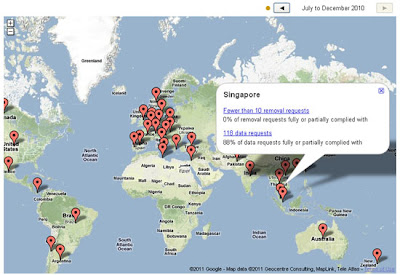
While Singapore had less than 10 Content Removal requests from Jan to Dec 2010 (the requests appear to be made from Jul to Dec 2010), Singapore made 106 User Data Requests from Jan to June 2010 of which none were complied by Google.

User Data Request Jul to Dec 2010

Interestingly, the report seems to indicate that the Google complied with none of the requests made in the first half of 2010. From Jul to Dec 2010, Singapore made 118 User Data Requests of which 88% were complied with. Looking at the percentages of data requests that were complied to partially or fully by Google, the United States of America tops the lists with 94% partial or full compliance with Japan coming in second with 90% out of 72 requests. Singapore is third on this list. Australia comes in fourth with 81% out of 345 requests.

It does leaves one to wonder if the compliance percentages were an immediate reflection of free speech or a reflection of how hard the governments pushed their cases.

Related articles:
- Google: Transparency Report
- Times of India: Google reveals who tops in web snooping
- The Telegraph: Google report reveals British government web snooping
- Wall Street Journal: India Often Asks Google to Snoop