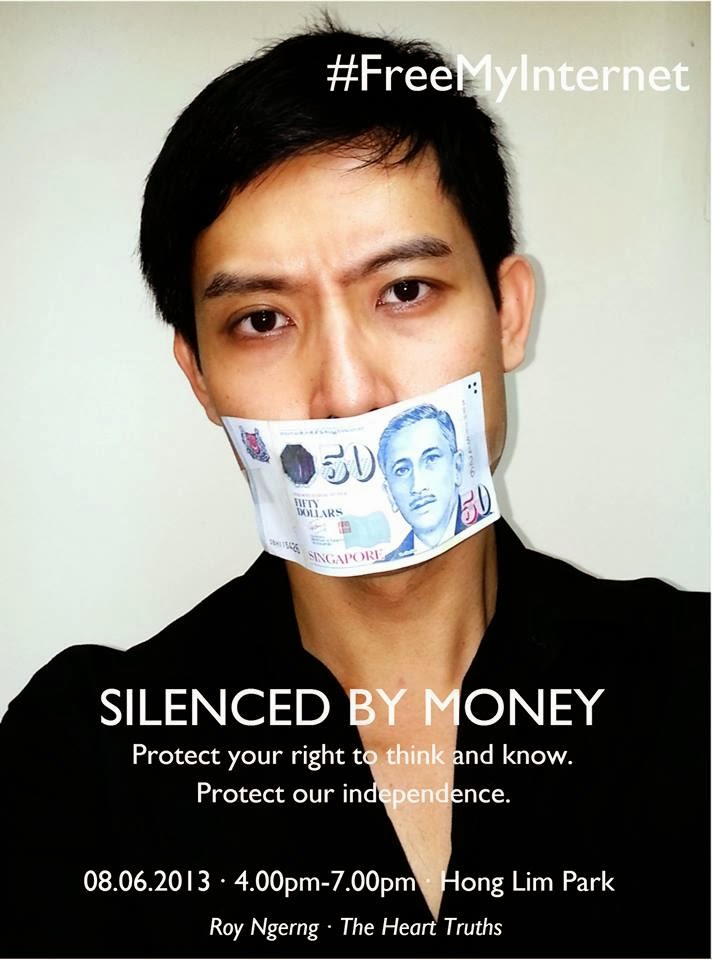
We have decided to bring life to this blog again by sharing this little known interview with Roy Ngerng by Kieran James.
It seems like back in 23 Oct 2013, he had already thought about entering politics. #throwback #weneverknew
From
Joo Chiat Road Online
An interview with activist Roy Ngerng (RoyYi Ling Sexiespider on Facebook), 23 October 2013 by Joo Chiat Road Online
| Roy Sexiespider (Photo credit: Shawn Byron Danker, Poster credit: Joshua Chiang) |
Kieran James (via Facebook messages): Please first of all tell us why and how you first became an opposition supporter.
Roy SS: I won’t say that I am an opposition supporter per se. Rather, I believe that Singapore needs a coalition government that is representative of the needs of the people. Within this coalition government, the PAP might make up between 20% to 35% of the seats, because this would be the proportion of the population that would have their values aligned to the PAP’s dogma. The Worker’s Party would take up about 30% of the seats, with the rest shared by the other political parties. This is how I believe a representative government, at this point in time, would look like.
Down the road, when the other political parties are able to operate on an equal playing field, the dynamics and the proportionate representation might change, as the political parties mature in their direction and vision, and a more mature electorate would then shift their alignments accordingly.
At this point, many Singaporeans have become “opposition-supporters” by default, because they no longer align with the values propounded by the PAP. At this point, most Singaporeans do not agree with the elitist and divisive policies created by the PAP.
There is a growing proportion of Singaporeans who believe in having a more equal society. As such, the more egalitarian values of the Worker’s Party (WP) and the more progressive policies of the Singapore Democratic Party (SDP) have appealed to this segment of Singaporeans, which would make up between 35% to 45% of the population at this point.
This also explains why the PAP is now trying to appear more “equal” in their manner of speech. This is also why Deputy Prime Minister Tharman Shanmugaratnam had wanted to pursue a perspective that within the PAP, the “weight of thinking (has shifted to) left-of-centre.”
However, it is not sufficient for a political party to make claims of their standpoints. To have a fuller appreciation of their value system, we would need to look at the policies they put out. For example, in the area of health, the PAP government spends only 1.4% of GDP, whereas the Singapore Progressive Party (SPP) and the Worker’s Party (WP) have both called for between 5% to 6% of GDP spending. Also, whereas the PAP government is only spending 31% on total health expenditure (with the rest paid privately and out-of-pocket), the SDP has called for the government to increase its contribution of the total health expenditure to 70%. All the other political parties – SDP, SPP and WP – have called for expenditure rates that are much closer to what high-income developed countries should be spending, and which would also reduce the income inequality that has been growing under the PAP.
KJ2: Can you give us details of any past or present activist projects you have been involved in?
RSS2: I was previously involved in the #FreeMyInternet (#FMI) movement. In the middle of this year, the Media Development Authority (MDA) had released a set of rules, and imposed them with almost immediate effect (a few days later), that “online news websites” with a readership of more than 50,000 over the span of two months, and which post an article for at least once every two weeks, could potentially face a penalty fee of $50,000 if the MDA believes that these sites have transgressed rules that the MDA had set out. The rules were enacted and passed without consultation with the citizens.
However, the “online news sites” and the blogger community were taken aback by this ruling as this would severely curtail the freedom of speech of Singaporeans and spaces for intellectual discourse. As such, the bloggers rallied together to create the #FMI movement and to also hold a protest to denounce these punitive measures and for the MDA to revoke this ruling. More than 2,000 had attended the protest.
As past cases had shown, the PAP government went ahead with the ruling in spite of our protests. It was suggested that the PAP had introduced this ruling to curb Yahoo! Singapore’s ability to critique the government’s policies. However, we can expect the government to impose this ruling on many of the other “online news sites” closer to the next general election, so as to reduce the channels of information that Singaporeans would be able to receive their sociopolitical analysis from.
KJ3: What are the topic areas you feel most strongly about where you feel PAP policies have let the country down?
RSS3: I believe that Singapore needs to become a more equal society. What we see in Singapore is a widening income gap, and a more divisive society. There are now much clearer lines drawn between the haves and the have-nots, and between Singaporeans and foreigners. This is the unfortunate repercussions of policies which were intended to favour a segment of the population. Prime Minister Lee Hsien Loong had said that, “if I can get another 10 billionaires to move to Singapore and set up their base here, my Gini coefficient will get worse but I think Singaporeans will be better off, because they will bring in business, bring in opportunities, open new doors and create new jobs, and I think that is the attitude with which we must approach this problem.”
However, not only have income inequality risen, the real incomes of the poorest 10% in Singapore has also dropped, even as those in the top 10% have risen the fastest. Also, because the wage share of Singaporeans remain the lowest among the high-income countries and developed countries, Singaporeans now receive the lowest wages and have the lowest purchasing power among the developed countries. Some surveys have also shown Singaporeans to have the smallest and least adequate retirement funds among the developed countries, and even compared to developing countries, like China, India, Indonesia, Malaysia and Thailand.
However, Singapore is also the richest countries in the world, if not, one of the richest.
The key question we have to ask is that, if our national wealth is increasing, can the share of the wealth be more equitably distributed? It is unfortunate that this doesn’t seem to be the standpoint that the PAP would like to take. A fairer and more equitable government would ensure that as prices and the cost of living goes up, higher subsidies would be given towards meeting the healthcare and housing needs of the people. However, Singapore continues to spend the lowest public spending, among the developed countries. Our 1.4% spending of GDP on health is also one of the lowest in the world. Also, our investment in education is also far lower than compared to the other developed countries.
Singapore has the one of the largest reserves and surpluses in the world, and one of the highest reserves per capita in the world. By some estimates, the reserves would be able to provide for Singaporeans for the next 20 to 30 years, even if we do not generate any income. Many Singaporeans have thus questioned that if the country has so much wealth in their reserves, could the government contribute more to the people’s basic needs, so that our elderly do not have to work in manual labour jobs past their retirement age (some without being able to retire), and so that the poor can feel financially secure to be able to look for jobs to protect their families?
The current Singapore government believes that increasing social assistance is a waste of resources as this does not increase the productivity of the economy, and would not lead to economic growth. However, the Nordic countries have much to teach us in this area, where the belief is that more social and financial assistance and investments would further increase the productivity of the population, as the people would then be able to redirect their focus towards finding gainful employment.
KJ4: What do you think of the tone and content of the anti-foreigner discourses going on in Singapore at the moment among opposition supporters?
RSS4: It is unfortunate that the tone of the debate have shifted to one that has become increasingly unfriendly. By and large, Singaporeans are a friendly and caring populace.
However, the collision of the social effects of several policies have led to the immense built-up of the anger among Singaporeans, which have spilled over into the larger social discourse.
First, the inability of Singaporeans to effectively participate in devising solutions for national policies has created a populace that feels increasingly disempowered. The discourse has thus degenerated towards one of mud-slinging and has created a “complaining” culture where in the lack of opportunity to effectively voice out solutions, we have allowed ourselves to enmesh our solutions into disempowered complaining. The adverse effects of a “complaining” culture are such that it has created a lot of pent up frustration. How much longer can you keep the lid on, when the anger is boiling within?
Second, a continuous stream of policies which had not been well-thought through and implemented have led to crippling effects in society, and have further fuelled the anger. The consistency in the PAP’s policies has been to the effect of increasing the profit margins, such that fewer housing was being built, so that the lack of supply could be justified to push prices up. Also, in an attempt to save on cost, the amount of investment to maintain the MRT tracks and drainage system dwindled, which resulted in poorer infrastructure quality. At the same time, there was a lack of financial investment to prepare for the sudden inflow of people into the country, which also means that the health system couldn’t catch up and had to undergo several rounds of restructuring, without any immediate impact, as long as the financial investment necessary to boost capacity isn’t there. Finally, the focus towards a low-cost economy has created a huge service sector, which also means that the education system has churned out workers which did not meet the needs of the current economic model. Singaporeans thus became disadvantaged by the system because the service industry would not yet restructure to pay higher wages to Singaporeans, and the segment of the worker population which had to compete with global talents for PMET jobs mean that this segment of Singaporeans were losing out as well.
However, statistically, all continue to look well in the books. However, the frustrations that Singaporeans are truly feeling from the ground are not something that the fudging of statistics can cover up with. As such, the current anti-foreigner sentiment that has arisen is a response to the lack of jobs, and well-paying jobs that Singaporeans are facing. Faced with a loss of jobs, the immediate attention that Singaporeans would focus on would be on foreigners, as the loss of their job to a foreigner would be the most visual impact of that loss. Also, around the world, it is as yet still “politically-correct” for people to be anti-foreigner since governments have yet to respond in an effective way to mediate these negative sentiments.
However, if one were to understand the sociopolitical background of Singapore, it would be easy to understand that the real unhappiness has arisen due to low wages and wages which had been depressed, and the lack of effective anti-discriminatory policies to protect workers from being unfairly replaced. The lack of an ability to adequately voice out for policy change, and the poor structural quality and capacity has only further compounded the issue. Finally, the underlying knowledge that the people feel of being lied to, when their realities are not in-sync with what the politicians claim, has only further spurred the anger within them of injustice that has been done to them. As such, the people have turned their anger onto the most obvious artifacts of the PAP government’s poor policy-making – the foreigners – and this anger have gone left, right, and centre.
In order to ameliorate the current divisive sentiment, a responsible government would need to immediately phase in the increase of wages, enact anti-discrimination laws and increase their financial investment towards improving the structural capacity of the lived environment. However, these have all not been done to the extent needed to mediate things. The government might have introduced the Wage Credit Scheme, to co-fund 40% of a worker’s wage increase. However, without the presence of a minimum wage and a policy measure to ensure that only low-income workers would benefit from this scheme, this scheme would not benefit the low-income workers, but instead benefit the higher-wage earners. Also, the government might have introduced the Fair Consideration Framework. However, the Ministry of Manpower (MOM) has not introduced any rules with which companies need to abide by and the hiring practices of companies would not be scrutinised, as the MOM had said that, “MOM does not review the merits of a firm’s hiring decision”. As such, this “framework” wouldn’t prevent unfair hiring practices as well.
The negative sentiments that exist, in the face of a PAP government which is unlikely to introduce policies which are necessary to tackle the root problems of the issue, can thus only be effectively resolved by an enlightened population which would be able to see beneath the complexities of their immediate feelings, and to be able to engage in a conversation that would help them redirect their focus onto policy discussions and advocacy. There is a strong role for civil society to play and to coordinate among themselves, towards helping Singaporeans re-imagine the kind of society that we want, and work towards it.
Only with effective, coordinated and collaborative advocacy towards the government to implement fairer and equal policies will we be able to bring Singapore back to social stability and peace.
KJ5: Without naming names, have you got any non-citizen friends presently who are opposition supporters?
RSS5: Lol. Yes, I do. In fact, I am pretty sure that for many new citizens who have taken up citizenship and who have to live the lives that Singaporeans have to, they would then come to an understanding of the fears and insecurities that Singaporeans have, that have led them to increasingly leave the PAP to support another party.
When you become inducted into the Singaporean livelihood, you would begin to realise the inadequate support that the government gives to your healthcare and housing. Coupled with the relatively low wages in a high-income country, it causes any Singaporean living here to live day-by-day in constant insecurity. If you are to fall sick one day and would require an operation, the Medisave and MediShield wouldn’t adequately cover your bills. This would mean huge medical bills, which if you aren’t able to pay off, would mean having to sell your home, as some low-income Singaporeans have resorted to do.
In fact, because 40% of Singaporeans have not bought additional health insurance, this would mean that having to go to a hospital would be a highly fearful journey, which also explains why we know of people who have chosen not to go to a hospital until they are very sickly, which by then, would create a further burden on the health system, and on their own lives. These are things that a responsible government can prevent and look into, for the health and security of its people.
As such, are new citizens likely to also turn away from the PAP in time to come? Once they have adequately lived through the policies of the PAP in the shoes as a Singaporean, this is a very high possibility.
KJ6: Do you think the opposition should reach out to foreigners either on a one-on-one personal friendship basis or as something more organized? (in the same way Australian churches often reach out to international students and Australian trade unions produce foreign language publications)
RSS6: I believe that most of the political parties understand the intricacies of how the issue of foreigners has played out in Singapore, and they do not subscribe to the voices of discrimination that is being played out.
I am also unaware of what activities they are currently conducting at this point, to be able to comment further on this.
However, at this point, civil society seems to be playing a larger role in this conversation, and it might be necessary to observe how the conversation might pan out, hopefully towards a more constructive and enlightened discourse which is not targeted at specific individuals.
It is not necessary for political parties to wade in. It would be wise for them to continue to focus on introducing more equal policies and to advocate for non-discriminatory practices.
KJ7: What do you think of Laurence Rappa's idea of replacing GRCs by a new system where 70% of SMCs can only have Chinese contestants, 15% only Malays, 10% only Indian and 5% only Other?
RSS7: I haven’t actually looked at the electoral system proposed by Laurence Rappa. However, my view is that the electoral boundaries constructed by the PAP government is essentially a perverse inversion of democratic processes, as many have already pointed out. By distorting boundaries for the sake of winning votes, the PAP has constructed a false imagery of support for their party and their policies. Essentially, what the PAP has done is to erect high barriers to entry for the opposition to participate in elections, through high election deposits and short campaigning periods, and to reduce the citizen’s ability to be sufficiently informed of local politics, as polls aren’t allowed to be conducted during election periods.
If we drill down to the basics, when we allow citizens to be adequately educated and informed of the ongoings in Singapore, and create an atmosphere that allow for critical comprehension, Singaporeans would naturally vote for a government that would be the most respectful and aligned to their needs as individuals. Thus if the government does its job, the people will vote for the government that performs to the best of its ability to protect the people.
And such a government doesn’t have to be one that is aligned to another party. When individual politicians are able to show to the citizens that they genuinely care for the people they represent and pursue policies that are fair and far-reaching, these politicians would naturally be put back into government. During my parents’ and grandparents’ time, people from the different ethnicities would form strong relationships and networks, without the need for policies to prod them in that direction. There wasn’t a need for a forced language policy as people would learn different languages, so that they could converse with one another and friends. In our country, we have gone to the extent of seeing colour, because of policies that continue to remind us of how different we are, and segregates us along lines of colour. When we remove such discriminatory policies, we would have a social landscape that would be less judgmental.
KJ8: Have you any comments on SDP's Malay policy?
RSS8: The SDP’s policy paper to improve the conditions of the Malay community in Singapore is essentially a proposal to achieve equality among Singaporeans. The SDP recognises the unequal policies that have been pursued in Singapore that have allowed some segments of the population to fall behind. As such, the SDP has proposed more equitable measures that can also allow the Malay community to be equally respected and valued in Singapore.
Work-wise, the SDP proposed minimum wage to protect the workers and fair employment, by enacting anti-discrimination laws. They had also proposed to provide an equal education platform so that regardless of which schools a child would attend, be it a national school or madrasahs, they would receive subsidies to allow them to benefit from access to education, as well as to nationalise pre-school education, so that fees are more affordable for families to be able to afford. On housing, they have also proposed cheaper housing and to remove the policy that restricts the different ethnic populations from living in certain areas, if the “ethnic quota” has been reached. Finally, the SDP had also proposed to increase the government’s expenditure on healthcare to allow people to receive adequate healthcare protection, and to remove discriminatory practices in the military.
These are all policy measures that I agree with. I believe that if we are able to create an equal society, where we pay equitable wages to the people, and provide more social protection to their livelihoods, through a more manageable cost of living, we would be able to create a society that would be more respectful and aware of one another’s needs, and work towards a society that would be uplifted together.
On top of that, from my understanding in conversations with friends from the other ethnicities, I understand that some form of discrimination continues to exist towards some ethnic groups. Imagine if we have a society where our young grow up in an environment where they are not pressure to perform for the sake of results, but where they are taught to value themselves and one another, and imagine a society where in our pathway towards personal growth, we learn to gain more respect for one another, I can imagine a day when we would be able to see beyond colour to see individuals for who they are. Eventually, I believe in an equal society because when we are able to achieve heightened awareness and consciousness towards other individuals, we would be able to see beyond what physically defines us, to see the characteristics within each of us that binds us.
KJ9: What do you think of increasing use of aliases by activists and the extension of this beyond Facebook to the physical world (thinking of Singa Crew here in particular)?
RSS9: This is an interesting phenomenon which I haven’t fully looked into. The usual explanation is that because many Singaporeans still fear the repercussions of a government which might come down on them for speaking up, they have thus chosen to use aliases so that their identity would be more protected.
However, another development could also be that many of these aliases that have been created along the lines of raising the awareness among Singaporeans on the issues surrounding Singapore. As such, the use of these aliases is in themselves advocacy imagery to rally Singaporeans around a future imagination of what Singapore can be.
I have met up with some of the people behind these aliases and they come across as thoughtful Singaporeans who care deeply about the country but who would not want too much attention to be focused on themselves. They would like to raise awareness on issues about Singapore, without having to use their identities or personalities as tools of influence. As such, the adoption of an alias would have the effect of refocusing the attention onto issues and ideas, to steer people towards thinking about solutions, instead of aligning towards the beliefs of any individuals. I would have to say that these are bold and respectable moves by these individuals.
Many a time, I have asked these individuals whether they would choose to stand as candidates for the next general election. They would explain that they don’t believe that this is their role, and that they would like to play a role behind the scenes. And I suppose every individual believe that they have a different role to play and in our own ways, and together, we are building momentum towards raising the awareness among Singaporeans on issues that concern them, to allow them to make a better decision as to how to live their lives and to select a government that would better respond to their needs.
On my part, when I had first decided to be upfront about the use of my name and photo on my blog and public mediums, it is a belief that if there are some of us who would put ourselves out, and to show others that we can stand up and speak up, whilst believing in the truth and necessity of doing so, this will hopefully motivate more people to also present themselves and rally Singaporeans into believing that the voice we represent is visible and credible. It was never my intention to allow my image or person to become a figure of influence. However, I do recognise that as the blog generates a sustained momentum, that I would need to sometimes step up into the public arena, and with it, comes added responsibility. As such, I have evolved the ways I communicate my messages across, so that they would allow more people to receive the facts and information that I have been able to uncover.
KJ10: Lastly, have you future plans to be involved with any opposition party and might you even contest in a future election (if yes for which party)?
RSS10: At this point, it is important that more Singaporeans stand up to represent themselves and one another, to advocate for more protection and the rights of all Singaporeans. We would need to join the other political parties to allow Singaporeans to see a credible show of force and aptitude in our commitment and strategic broad understanding towards managing the stability and economic progress of Singapore.
In order to do so, more Singaporeans would need to join the political parties to speak up on the necessary solutions to bring Singapore forward and to reframe the ideology in Singapore to be one that would be more respectful of a broader segment of Singaporeans.
It is in this light that I would like to also be able to participate in the elections as a representative. If I could allow myself to be a candidate and if as a whole, we could come together and consolidate support and win more seats, so that we could put in place a coalition government which could enact policies to protect Singaporeans, I would like to have the opportunity to do so.
I believe that we need to move Singapore towards a more equal and principled environment, where Singaporeans could feel more secure in their livelihoods, by being equitably remunerated for their work, and to be able to well taken care of by a system which ensure that they would be able to receive bountiful support in education, healthcare and housing. It is the responsibility of a government to take care of its people, and to ensure that their basic needs are properly met. It is also the responsibility of the government to create an environment and society that is conducive towards allowing the people to be able to achieve inner growth and awareness, and to reach their fullest potential. To do so, we need a responsible government which is cognizant of this responsibility, and put in place the necessary policies to create equality and care for its citizens.


 Kong said he scrutinised budget for her debut English album